Starts with the birth of an orphan “orphanogenesis” in a post singularity world. Citizens live in polises, and experience in ways completely foreign to us (gestalts and linear modes). There are no limits on individual expression, connection, and creation of new individuals.
The development of a mind is similar to what I remember in Permutation City of the development of the various levels of simulated worlds (very automata like). The creation of minds and what is and isn’t natural in the development of a being reminds me of the cognitive science and psychology stuff in Blindsight, though the tone is more positive here.
I really liked this part - the exploration of a being starting with just trying to understand how to interact with the polis library and symbols. Yatima starts with viewing lots of data, making primitive associations and creating symbols in ver mind. Then, ve enters a scape - without a tag for self because ve has no sense of self yet, and attempts to communicate with others. This is seen as slightly improper, but ver repetition and eventual modeling of how other icons act helps ver understand that ve verself is an icon / person. Ve creates symbols for the others in ver mind, and realizes another icon exists, which reacts to ver commands - with the realization that this icon is a self, Ve becomes a citizen in the eyes of the polis.
The realization of self-awareness being non-obvious is really interesting! Yatima realizes that other citizens exist and creates symbols for them and how ve predicts they will act before ve has a symbol for verself.
Has Egan’s classic style of having cool thought experiments and math stuff in here, like Schild’s Ladder and Permutation City.
Even though you could paste a mathematical genius’s understanding of mathematics onto you, people don’t do that, as it puts you in the exact same place as them. Mining in the truth mines on your own introduces some randomness and variety into the way you view the world. At the end of the day, it’s better to have an organic random search over rigid mind development.
Being able to shape manifolds and create scapes and projections is pretty cool - similar to Schild’s Ladder, where one of the main characters grows up in a space with different physics.
Outlooks are interfaces that change the way one thinks (a cyberperson).
Getting to the surface and realizing that they are facing the problem that The Metamorphosis of Prime Intellect faces at the end of the book in cyberspace, but in real life. People are self modifying, and diverging - becoming unable to communicate or relate to each other. Their solution is interesting - create a genetic range with extremities that can talk to the furthest branches, and have a continuum along that range (such that each person is close enough that they can talk to their neighbors) so that there can exist a chain of people that can facilitate communication between any two people.
engineering = empathy
paleo-cybernetics
In part 2, Yatima and Inoshiro find out about a neutron star merger thats going to do massive damage to fleshers living in Atlanta. There is pretty strict separation between fleshers (flesh and blood), citizens (digital minds), and gleisners (robots). They have to deal with whether they should violate fleshers’ autonomy to save them from the destruction of their environment. In the end, a lot of fleshers die.
In the next part, Gabriel and Blanca go through the experiments to create the first micro wormholes to achieve FTL travel. This doesn’t work as expected - wormholes take the same time to travel as a regular path. Wormholes are abandoned and the C-Z (realist) polis decides to send ships towards a thousand star systems with copies of its inhabitants, following the gleisners. Blanca, while on a ship, discovers a different permutation of Kozuch theory (something that appears to be similar to current string theories), with 12 additional dimensions instead of 6 that could allow wormholes that match the behavior that they saw. Basically - this would involve not 6-spheres at every point, but 6-spheres at every point, and the whole universe embedded in (I think) macroscopic bulk dimensions that the particles that travel through the wormhole travel through. Ve does not advertise this as the Carter-Zimmerman polis appears to have had a backlash to the seeming abstractions of Kozuch theory, so 6 additional dimensions might be too far (this is happening with some current views on string theory too, interestingly). Unfortately, ver ship, headed to Fomalhaut, is lost.
Weird radiations of societies
- polis that’s rushing to view mountains erode in near real time
- Schild’s Ladder has an interesting bit on this where an entire planet slows down time significantly to keep track with some of their citizens that left. Syncing clocks is a hard problem in the post singularity universe
- Dream Apes - basically de-evolved humans who lost the ability to think like humans do
There’s still some level of factionalism and trying to beat other factions even though we’re in a post scarcity world, and the radiant evolution of life means that they don’t even care about the same things.
The next main character is Paolo, who is on the first ship that reaches a world, and that world appears to have life on it - “Wang’s Carpets”. There’s some debate on whether to send probes or not, out of fear of being invasive (they start with neutrino-based detectors). They discover these carpets are single molecule macroscopic life forms which are a single space filling manifold of carbohydrates that self catalyze to grow. They appear to be around a meter thick, but in actuality the molecule is only about as think as a layer of skin. I imagine a non repeating manifold that looks something like a gyroid
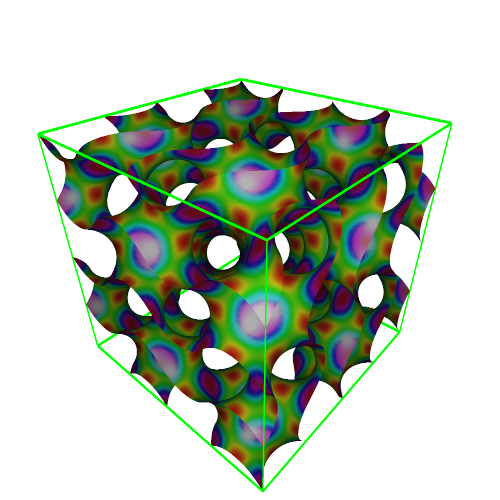
Turns out Wang’s Carpets are turing machines that simulate life - new rows are like doing a single operation on a turing machine’s tape. Looking at the history of the patterns on the tape by looking at the carpet as a whole, their patterns can be broken down into a much higher dimensional space where creatures move around with a rich 16 dimensional sense of touch. Perhaps these carpets should be called tapestries instead! Karpal (the gleisner who finds the neutron stars colliding) is the one who shows this to Paolo - he actually only shows the principal dimensions of this frequency space, which is really interesting - it gives the idea of these creatures living in a really high dimensional space where not all dimensions are equal - where the dimensions themselves are fractal in nature perhaps - maybe like how theoretical minuscule dimensions could be in our world.
The proposed evolution of these things feels a little glossed over - fierce competition in autocatalytic reactions somehow turns into “the ability to respond to selection pressure has itself been selected for”, which in turn becomes a tapestry that encodes a universe itself?
Paolo thinks C-Z would find this heretical - which tells of how far they take their absolute realism - the first Aliens they find are actually inside their own computers, just like the inward looking polises they left behind. His reaction to going into the frequency space, like they don’t do that a lot, is also curious - its different from how things are in Schild’s Ladder. C-Z is trying to be like star trek while other polises are trying to be like the digital brained buddhists.
The modeling of self and others is something thats touched on (its spelled out a bit more in orphanogenesis, with the emergence of Yatima’s self awareness) in the chapters with Paolo. communication and self models
As I read this more, I think you could view this as an unofficial trilogy Permutation City as the first book - in the near future, where we’re just starting to figure out brain uploads Diaspora as the second - where we are just starting to spread across the stars, and themes of digital life and the divergence of experience and deeper time start to be more real. They start to try and understand reality more fundamentally Schild’s Ladder is finally the third book, where digital minds are spread across vast regions of space, and deals with grand problems like the end of the universe.
The next part deals with a Orlando (Paolo’s father, originally a human from the beginning of the book) and the discovery of a heavy planet. His system is Voltaire, where they find a planet (Swift) that was seemingly designed to last longer - every atom on the planet has an extra neutron compared to the standard isotope. This is very clearly unnatural, so they name the race that did this the “Transmuters”. Yatima and the rest of the polis spend some time trying to figure out what’s going on, and they discover the message in the neutrons themselves - which turn out to be long neutrons - wormholes with polarities that encode data. This data shows gamma ray bursts on many systems nearby, including a correct prediction of Lacerta, more than a 1000 years in advance, and predicts another one coming soon.
The rest of the data is then figured out by Blanca, who has isolated verself in order to run in a non-human timescale. Ve figures that the rest of the data actually encodes the structure of the long neutron, which passes through many other universes and forms a complex structure embedded in the macrosphere - the 6D space that the universes are embedded in. It’s almost like a protein - and it’s self catalytic - it can build structures in the macrosphere. They hypothesize that the transmuters used it to escape into the macrosphere, ascending to 6 dimensions, and they will follow.
They talk about 6D physics (5 space and 1 time) works for a bit, and how cosmology and chemistry develop in U* (the macrosphere space / dual universe). No stable orbits exist, and matter is a lot more dense - regular chemistry and nuclear chemistry interact a lot.
In U*, they end up at a star they call Poincaré. Orlando deals with the difficulty of living in 5 spatial dimensions - where living in a 3 dimensional subspace leaves you hopelessly unable to understand the universe, while anything 5 dimensional overwhelms your 3d sensibilities utterly. It’s a fine line between claustrophobia going from 5d → 3d and overstimulation from 3d → 5d.
The singularity slips and they lose about 300 years (time in U* is not bound to time in U) - if they lose the singularity, they’ll lose their path to U.
Life is discovered on Poincaré - its dynamically stable and resistant to environmental changes. They think these are the transmuters, or living polises - but can’t communicate with them. Orlando sacrifices clones of himself to bridge the gap to the 5D life, and communicate with them - most of the clones end themselves, but he combines with a version of himself that is 5D. They point them to another waypoint where the transmuters leave a similar long nucleon / wormhole that catalyzes reactions in the next universe.
Orlando’s willingness to have claustrophobia and many divergent experiences come back to him after the diaspora is noble.
This solves the diaspora - there are infinite universes up and down (U** exists, and U^n** exists), and they can create polises close to nucleon singularities to protect from threats in individual universes. Orlando and the others presumably unite, and explore universes to find other intelligent lifeforms. They choose to join the galactic community.
Yatima and Paolo keep ascending through the macrospheres to find the transmuters. They start to find spheres and hyperspheres of various sizes and shapes along their route - but can’t parse what these mean. Yatima and Paolo continue a while, and start to rush through the universes, trying to find the transmuters. Their connections to lower universes start slipping more and more - they continue ahead anyways - return is either possible, or not. Once they get to the end, they realize that these were all polises, and the transmuters have experienced everything they need to, and have ended themselves, leaving a high dimensional sculpture to their own existence (the spheres). Paolo chooses to follow the transmuters, but Yatima returns to the truth mines to explore the space of ideas.
Diaspora is about the radiation of life and intelligence and ideas. What’s the catalyst for it? When is the point of no return? How does it feel to move away from your home? Orlando is the most relatable to us in some ways - he starts as flesh and blood, then moves to the digital world (in a realist polis), with the hope of coming back to reality, but then he moves to U*, a different reality altogether. The hope of returning to a reality he is familiar with growing smaller and smaller. The move from 3 → 5 spatial dimensions especially shows this. Yatima is extremely relatable to me - I find the descriptions of Orphanogenesis strikingly similar to some of what I experienced with understanding my own self awareness as a child - ver starting to understand others and verself as symbols in ver own mind. Ve starts alone, and ends alone exploring ideas after exploring space.